


Capturing plastic before it reaches the ocean is one thing. Creating the business model and value chain needed to keep collection systems running is another. Through the Riverguard Initiative, Ocean Plastic Forum, All In On Green and Clean – the Danish Water and Environmental Cluster – are joining forces to connect plastic collection with sorting, recycling, manufacturing and the market.
Plastic pollution in rivers and waterways is a visible environmental challenge. Around the world, solutions already exist to collect plastic and other floating waste before it makes its way into the ocean.
But collection alone does not solve the problem. Many collection systems depend on project funding, sponsorships or other external financing. When that funding ends, operations risk coming to a halt. At the same time, plastic recovered from waterways alone is typically insufficient in both volume and quality to make recycling economically viable. This is the challenge the Riverguard Initiative aims to address.
What happens to the plastic afterwards?
The Riverguard Initiative is built on the understanding that a long-term solution requires more than technology to collect plastic.
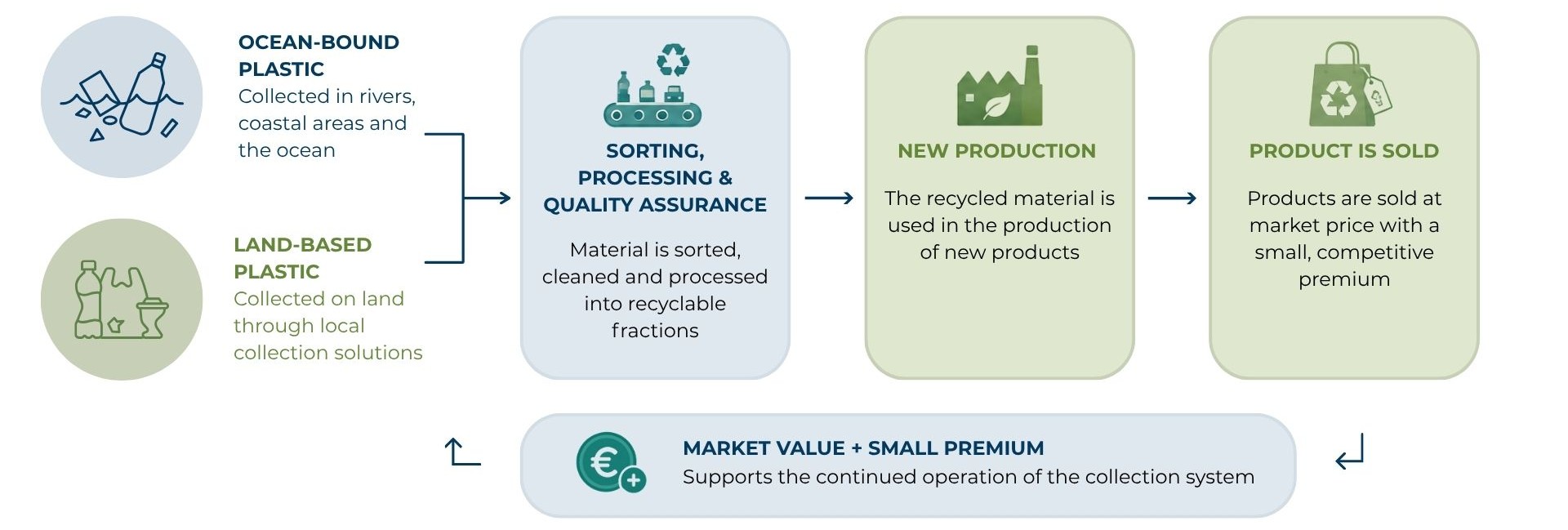
The material also needs to be sorted and processed. Manufacturers must be able to use it, and there needs to be a market for the products created at the other end of the value chain. Riverguard therefore connects all these stages into one value chain.
Usable plastic recovered from rivers and waterways is combined with larger volumes of locally collected, land-based post-consumer plastic. This is intended to provide the volume and material quality needed to process the plastic and turn it into new products.
Bringing value back to the beginning of the chain
This is where a crucial part of the model comes into play: The value chain should not end when the plastic has been turned into a new product.
The products are intended to be sold at market prices with a small, competitive premium. Part of this additional value will be channelled back to help finance the continued operation and maintenance of the collection systems.
Material flows must also be traceable and certified, making it possible to document where the plastic comes from and verify that recycled plastic is used in the final products.
Three partners connecting different parts of the value chain
The Riverguard Initiative is a partnership between Ocean Plastic Forum, All In On Green and Clean – the Danish Water and Environmental Cluster.
Ocean Plastic Forum serves as the coordinating and facilitating partner for the overall value chain. Its role includes connecting collection, sorting and recycling activities, supporting certification and traceability, and engaging with potential buyers of recycled materials.
“The Riverguard Initiative is something of a dream scenario for us at Ocean Plastic Forum. We have extensive experience bringing companies together to turn ocean plastic into new products. But this time, we have the complete package to take into the field. Alongside the value chain and certification, we have a Danish-developed barrier technology from All In On Green – and thanks to Clean’s global network, we can connect with the right markets and customers much faster than if we had to handle all the outreach ourselves.”
— Thomas Alstrup, Head of Secretariat, Ocean Plastic Forum
All In On Green contributes technology and operational experience in collecting floating waste from waterways. The company will help select and implement collection solutions and provide expertise on their operation and maintenance.
“The Riverguard Initiative is the right choice because we don’t just want to stop waste before it reaches the ocean – we also want to bring those resources back into circulation. By combining technology, partnerships and circular thinking, we’re creating an approach that protects the aquatic environment while taking responsibility for the waste we collect.”
— Frank Rosenberg, CSO, All In On Green
Clean contributes international project development, networks and strategic partnerships. This includes identifying relevant geographical areas, connecting public and private stakeholders, supporting the mobilisation of initial funding, and identifying potential buyers and partners.
Together, the ambition is to develop a model in which the entire value chain is connected – technically, commercially and locally.
From individual projects to a replicable model
Riverguard is not tied to a single collection project. The partnership aims to establish a framework for projects that connect local conditions, collection solutions, plastic waste streams, processing facilities, manufacturers and buyers from the outset.
“At Clean, we have been working with the challenges of plastic pollution and the marine environment across several continents for many years. We know that finding solutions requires collaboration between businesses, authorities and other stakeholders. Through Riverguard, we can put our international network and experience to work, helping to build value chains that turn promising technologies into practical solutions.”
— Henrik Bjørnager, COO, Clean
At the same time, the projects will focus on creating local value. The Riverguard Initiative aims to strengthen local skills and partnerships while contributing to better social and working conditions for people involved in the value chain.
The goal is therefore not simply to remove plastic from the water, but to establish a model that addresses what happens before, during and after collection.
Help build the next Riverguard value chain
The Riverguard Initiative is looking for partners to join future value chains and projects – from local organisations and collection operators to companies working with sorting, recycling and manufacturing, as well as potential buyers.
Does your company, organisation or municipality have relevant technology, plastic waste streams, manufacturing capabilities, access to markets or a potential project location? Get in touch with the partners behind the Riverguard Initiative to explore opportunities for collaboration.
Facts about plastic pollution in the oceans
- Approximately 10 million tonnes of plastic waste enter the world’s oceans every year. In 2019, the total amount of plastic in the oceans was estimated at 86 million tonnes.
- Most marine litter originates from land-based sources, with rivers playing a significant role in transporting waste to the ocean. Several studies have estimated that up to 80% of marine litter reaches the oceans via rivers.
- Studies of litter in European rivers also show that plastic accounts for a significant share of the pollution. Plastic has made up between 56% and 89% of recorded litter, with an average of 75%.
Sources
Report: Plastic waste streams into South Baltic Sea: https://circularoceanplastic.eu/new-publication-a-review-of-ocean-bound-plastic-from-source-to-solution/
Report: Spatial assessment of litter pollution along urban riverfronts: https://www.cleancluster.dk/wp-content/uploads/2025/08/Spatial-assessment-of-litter-pollution-along-urban-riverfronts_2025.pdf
Publication: A review of ocean-bound plastic from source to solution: https://circularoceanplastic.eu/new-publication-a-review-of-ocean-bound-plastic-from-source-to-solution/